
Squirrel Hub Page
Squirrels in your attic are chewing through your wiring right now. We stop them permanently.
Squirrels aren’t just noisy. They’re one of the most destructive animals that invade Kansas City homes. They chew through electrical wiring, creating a fire hazard, tear apart insulation, gnaw through wood framing, and cause thousands of dollars in damage that homeowners insurance typically won’t cover. Midway Pest Management humanely evicts squirrels from structures using one-way exclusion devices and seals every entry point so they can never get back in.
✓ Humane exclusion & permanent sealing. One-way devices let squirrels exit safely, then we seal every entry point with chew-proof materials so they can’t return.
Squirrels aren’t cute when they’re inside your walls
Most homeowners don’t realize how much damage squirrels cause until they see the bill. Squirrels chew constantly, because their teeth grow throughout their lives and they gnaw on anything to wear them down. That includes your home’s most critical systems.
Electrical wiring, your #1 fire risk
This is the most dangerous thing squirrels do. They chew through the insulation on electrical wires in your attic and walls, exposing bare copper. Damaged wiring hidden behind insulation and drywall is a documented cause of house fires. You’d never know it was happening until an electrician or pest inspector finds it, or until something catches fire. This alone makes squirrel removal urgent.
Structural wood damage
Squirrels gnaw through roof decking, fascia boards, rafter tails, and soffit panels to create and maintain entry points. Unlike mice that squeeze through existing gaps, squirrels create their own by chewing through solid wood. They’ll chew a new hole in 24 hours if you block the original one with anything less than steel or heavy gauge hardware cloth.
Insulation destruction
Squirrels tear apart attic insulation to build large nests, pulling fibers loose, compacting material into dense nest balls, and creating bare spots where your attic has zero thermal protection. They also contaminate insulation with urine, feces, and cached food such as acorns, nuts, and seeds that attract insects and secondary pest problems.
Everything squirrels damage inside your home
Squirrels don’t just sit in your attic. They’re actively destroying components of your home every single day they’re inside.
PEX & CPVC plumbing lines
Squirrels chew through PEX and CPVC water lines in attics, causing leaks that can go undetected until water damage appears on ceilings below. A chewed plumbing line in a hard-to-reach attic area can cause thousands in water damage before you even know it happened.
HVAC ductwork
Flexible HVAC duct in attics is an easy target. Squirrels tear through the outer jacket and insulation wrap to access the warm air inside or to use the material for nesting. Damaged ducts leak conditioned air into your attic, wasting energy and reducing your system’s efficiency.
Roof & soffit damage
Squirrels chew through fascia boards, soffit panels, roof vents, gable vents, and even shingles to create entry points. Once they establish a way in, they maintain it, returning to the same hole daily. Patching with wood or foam is pointless, since they’ll chew through it overnight. Only metal exclusion materials stop them.
Food caching attracts more pests
Squirrels hoard food in attic insulation: acorns, walnuts, seeds, and other organic material. This cached food attracts secondary pests including beetles, moths, ants, and even mice. One squirrel problem becomes multiple pest problems over time.
Urine & feces contamination
Like all attic wildlife, squirrels contaminate insulation with urine and feces. Their urine has a strong, persistent odor that permeates through ceilings into living spaces. In severe cases, urine saturation causes visible staining on drywall below. Feces carry Salmonella and Leptospira bacteria.
Noise & sleep disruption
Squirrels are diurnal, meaning they’re active during the day, especially early morning and late afternoon. You’ll hear running, scratching, gnawing, and thumping in your attic and walls. Many homeowners report being woken up at dawn by squirrel activity directly above their bedroom. Unlike mice, which are nocturnal and quiet, squirrels are loud and disruptive.
How to know if squirrels are in your home
Squirrel infestations are easier to detect than mice because squirrels are larger and louder. If you notice any of these signs, call us. Every day they’re inside, the damage increases.
Daytime noises in attic or walls
Running, scratching, and thumping sounds in your attic or walls during daylight hours, especially early morning between 6 and 8am and late afternoon between 4 and 6pm. This is the number one sign. Mice are nocturnal, so if you hear activity during the day, it’s almost always squirrels.
Chew marks on exterior
Look at your roofline, soffits, fascia boards, and roof vents. Squirrel chew marks are distinctive: rough, splintered edges on wood or plastic, typically 2 to 3 inches in diameter. Check where tree branches overhang or come within 6 to 8 feet of your roof.
Droppings & urine odor
Squirrel droppings are larger than mouse droppings, about the size of a raisin, dark brown, and barrel-shaped with rounded ends. A strong, persistent musty or ammonia odor from your attic or upper-floor ceiling areas indicates urine saturation in insulation.
Nesting material
Squirrels build large, visible nests from shredded insulation, leaves, twigs, cardboard, and fabric. Unlike mice which nest in small hidden spaces, squirrel nests can be softball-sized or larger and are often visible when you look into the attic.
Squirrels on your roof
If you see squirrels regularly running along your roofline, climbing down from your roof, or disappearing into your soffits or vents, they’re not visiting. They live there. Watch for squirrels entering and exiting the same spot at the same time each day.
Power outages or flickering lights
Unexplained electrical issues such as tripped breakers, flickering lights, or outlets that stop working can indicate squirrel damage to wiring in your attic or walls. This is the most dangerous sign. If you’re experiencing electrical issues and hearing attic noises, get an inspection immediately.
Our squirrel removal & exclusion process
We don’t trap and relocate squirrels. We evict them through one-way exclusion devices, confirm they’ve vacated, and permanently seal your home with chew-proof materials so they can never return.
Complete property inspection
We inspect your entire roofline, soffits, fascia, gable vents, roof vents, plumbing boots, and every seam where different building materials meet. We identify every active and potential entry point, assess the interior damage in your attic, check wiring and plumbing, and determine the population size. You get a full written assessment before we begin.
One-way exclusion devices
We install one-way exclusion devices at active entry points. Squirrels exit through the device during their normal daily activity but cannot re-enter. We monitor over several days to confirm all squirrels, including any young, have vacated. For mothers with babies in the attic, we time the exclusion so she can take her young with her when she exits. No squirrels are trapped or relocated off-site. They leave on their own and move on naturally.
Permanent entry point sealing
Once vacancy is confirmed, we seal every entry point with chew-proof materials: galvanized steel mesh, heavy-gauge hardware cloth, steel flashing, and metal-backed exclusion materials. Squirrels chew through wood, plastic, aluminum soffit, and foam, so every seal must use materials they can’t defeat. If structural damage requires carpentry or roofing work beyond sealing, we document it and advise you on the right contractor.
Tree & branch assessment
Squirrels access your roof by jumping from tree branches, and they can leap 8 to 10 feet horizontally. We identify which trees and branches are providing roof access and recommend trimming. Cutting back branches to 8 or 10 feet from your roofline eliminates their primary launch points and dramatically reduces future risk.
Damage assessment & documentation
We inspect all wiring for chew damage, which is the fire hazard, check plumbing lines, assess insulation condition, and document any structural damage. You receive a complete report of findings with photos. For extensive wiring damage, we recommend a licensed electrician.
Attic restoration when needed
If squirrels have significantly contaminated or destroyed your insulation, we offer attic restoration: insulation removal, sanitization, deodorization, and TAP® pest control insulation replacement. Not every job needs it, and we assess honestly.
Squirrel species in the Kansas City metro
Three squirrel species commonly invade KC-area homes. Species identification matters practically, because device sizing and material gauge both depend on which animal you have.
Eastern Gray Squirrel
The most common attic invader in Kansas City. Gray or silver-gray fur, 18 to 20 inches including tail. Extremely persistent chewers that can gnaw through aluminum soffit and thin wood. They’re active year-round and breed twice per year, once in late winter during February and March and once in midsummer during June and July. Litters of 2 to 5 young mean populations grow fast.
Fox Squirrel
Larger than gray squirrels at 20 to 24 inches, with rusty orange-brown fur. More common in Olathe, Gardner, and western Johnson County neighborhoods near open land. Fox squirrels cause more damage because they’re larger and stronger, and they require larger one-way devices and heavier gauge sealing materials than Eastern Grays. They’re especially attracted to attics in fall when they’re caching food for winter.
Flying Squirrel
Smaller at 8 to 10 inches, nocturnal, and often mistaken for mice because homeowners hear nighttime activity. Gray-brown with a flat tail and gliding membranes between their legs. Flying squirrels enter through very small gaps, similar to mouse entry points. They’re colonial and can have 10 to 20 individuals in one attic, which means exclusion takes longer and every gap has to be found. More common than most KC homeowners realize.
Squirrel activity patterns in Kansas City, by season
Squirrel calls spike at predictable times each year. Understanding the seasonal pattern helps you recognize the signs early, before damage becomes severe.
Peak invasion season. Squirrels aggressively seek warm shelter and food caching locations before winter. This is when most new infestations begin, and when we get the most calls.
Squirrels are already established and active daily. Chewing and nesting intensify as they build insulated nests for warmth. Wiring damage accelerates. Late winter, February and March, is the first breeding season, when females seek secure attic spaces to birth and raise young.
Baby squirrels born in February and March are now mobile and active. You’ll hear significantly more noise as juveniles explore the attic. This is also when young squirrels start chewing on their own, compounding the damage.
Second breeding season, June and July, produces another litter. Full tree canopy gives squirrels maximum roof access via overhanging branches. Established colonies are at peak population.
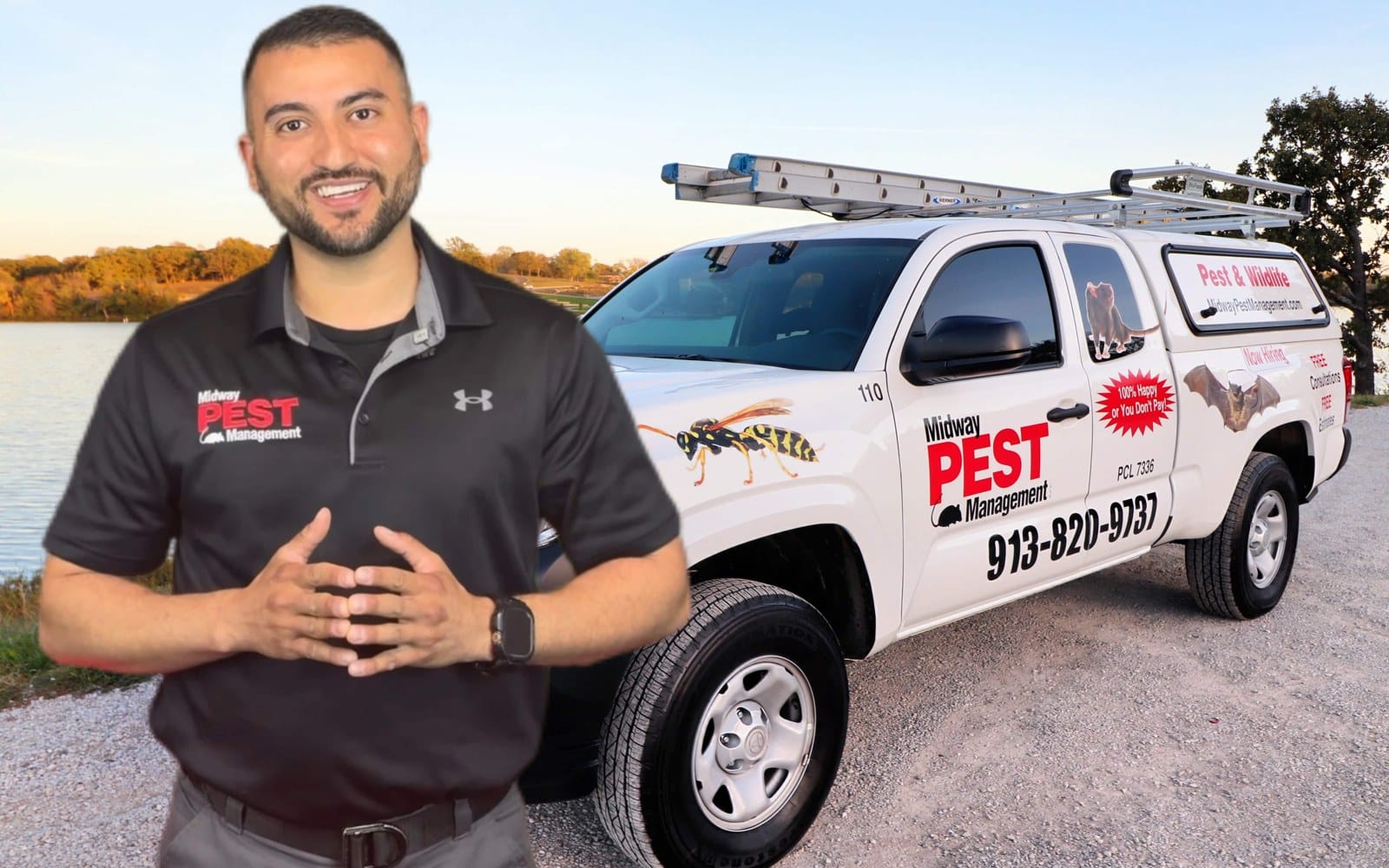
Dear Kansas City Homeowner,
“If squirrels are in your attic, the damage they’re doing to your wiring is a fire hazard you can’t afford to ignore.“
My name is Luis Gonzalez. I own Midway Pest Management right here in Olathe. Squirrel calls are some of the most urgent we handle, because unlike mice that contaminate, squirrels actively destroy. They chew through wiring, tear apart insulation, gnaw through wood, and they do it fast.
Our approach is humane exclusion, not trapping and relocating. We install one-way devices at every active entry point, monitor over several days to confirm every squirrel has left, then permanently seal your home with chew-proof materials. This method is more effective than trapping because it addresses the structure itself. A trapped squirrel that gets relocated is replaced by the next one that finds the same open hole. Our method closes the hole permanently.
What frustrates me most is when homeowners tell me they’ve been hearing noises for months but assumed it would “work itself out.” It doesn’t. Squirrels don’t leave on their own. They breed in your attic twice a year, and every day they’re inside, the damage compounds.
My commitment on every squirrel job
We inspect your full roofline and attic, evict every squirrel humanely through one-way devices, seal every entry point with chew-proof materials, and assess all wiring and structural damage. If squirrels re-enter through an entry point we sealed, we come back at no charge.
Don’t wait on this one. Call us today.
What KC-area homeowners say about our wildlife work
“Roberto was able to find the source of our issue within 30 minutes, one that had evaded several other companies for over a decade! Midway was prompt, efficient and professional!”
“The service we received from Midway was truly outstanding! They were efficient and kept a close eye on our situation. Luis was so kind and available whenever we needed help.”
“Luis was fantastic. Knowledgeable, professional, and took the time to explain everything clearly. Highly recommend working with him.”
“We had Luis out for an inspection. Thorough, knowledgeable, no pressure. Looking forward to working with Midway.”
“Have really been pleased with the quality of pest control they provide. Roberto is very informed and detailed in his work.”
“Extremely efficient and reliable work! Am so grateful for Luis! He deserves a million stars!”
Squirrel removal FAQ
Thorough answers to the questions Kansas City homeowners ask most about squirrels in their homes.
Do you trap and relocate squirrels?
No. We use humane one-way exclusion devices. Squirrels exit the structure through the device during their normal activity and cannot re-enter. We monitor over several days to confirm all squirrels have vacated, then permanently seal every entry point. This approach is more effective than trapping because it closes the entry permanently. A trapped and relocated squirrel is replaced by the next one that finds the same open hole.
How do squirrels get into my attic?
Squirrels jump from tree branches onto your roof, leaping 8 to 10 feet, and chew through soffits, fascia, roof vents, gable vents, or gaps where different building materials meet. Unlike mice that use existing gaps, squirrels create their own by gnawing through wood, aluminum soffit, and plastic vent covers. They can chew a new entry hole in less than 24 hours.
Can squirrels really cause a house fire?
Yes. Squirrels chew through electrical wire insulation, exposing bare conductors that can arc and ignite surrounding insulation or wood. This is a documented cause of residential fires. The risk is especially high because the damage is hidden. Chewed wires in attic insulation or behind walls are invisible until an inspector finds them or something goes wrong.
What about baby squirrels in the attic?
If we identify young squirrels during inspection, we time the one-way exclusion so the mother can exit, retrieve her young, and move on with them naturally. We monitor the den over several days to confirm the entire family has vacated before sealing. We never seal a mother out with babies inside, because that creates far worse problems, including dead animals in your attic.
Will squirrels leave on their own?
No. Once squirrels establish a nest in your attic, they don’t voluntarily leave. They breed there twice per year, cache food there, and return to the same nest site year after year. Without professional exclusion, the population only grows.
Why can’t I just block the hole?
Two reasons. First, materials: wood filler, spray foam, steel wool, and light-gauge metal won’t stop them, and they’ll chew a new hole within hours. Second, timing: if you seal while squirrels are still inside, they chew their way out and make a bigger hole than the one you closed. We confirm the structure is empty before anything gets sealed, and we seal with heavy-gauge galvanized hardware cloth, steel flashing, and metal-backed materials.
Should I trim my trees?
Yes, this is one of the most effective preventive measures. Squirrels access your roof primarily by jumping from overhanging branches. Trimming branches back to 8 or 10 feet from your roofline eliminates their primary launch points. We’ll identify which specific trees and branches are providing access during our inspection.
Do you do structural repairs?
We seal every entry point with chew-proof materials to prevent re-entry, and that work is guaranteed. If squirrels caused damage that requires carpentry or roofing work beyond sealing, we document it with photos and advise you on the right trade. For interior contamination, including chewed insulation and urine saturation, we handle attic restoration: insulation removal, sanitization, deodorization, and TAP® insulation replacement. For extensive wiring damage, we recommend a licensed electrician.
Squirrel removal across Kansas City, with city-specific expertise
Every city has different tree canopy, terrain, and construction that affect how squirrels access your home. We’ve built dedicated guides for the cities we serve most.
Squirrel removal in Olathe
Creek corridors, K-7 development, builder-grade soffits on newer homes. Our home base, and the fastest response in the city.
Squirrel removal in Overland Park
Densest tree canopy in Johnson County. Indian Creek and Tomahawk Creek corridors. Multi-entry infestations from aging rooflines.
Squirrel removal in Lenexa
1,600 acres of Shawnee Mission Park next door. Heavy-duty sealing for park-level squirrel pressure.
Squirrel removal in Shawnee
Three wildlife corridors converge: Turkey Creek, the Kansas River, and Shawnee Mission Park. Creek-side tree management is critical.
Squirrel removal in Lee’s Summit
Wooded ravines, hillside terrain, Fox Squirrels, walkout basements. Missouri-side expertise for different construction and species.
Every day squirrels are in your attic,
the damage gets worse and the risk gets higher.
Chewed wiring. Destroyed insulation. Fire hazard. Don’t wait for a bigger problem. Midway Pest Management evicts squirrels humanely and seals your home permanently. No trapping. No relocation. Free consultation.