
Nuisance Wildlife Removal Kansas City
Wild animals belong outside your home, and our job is keeping them there.
Skunks under your deck. Opossums in your garage. Snakes in your window wells. Groundhogs undermining your foundation. Armadillos tearing up your landscaping. Midway Pest Management specializes in structural exclusion: getting animals out of your walls, attic, crawl space, and living areas using one-way devices instead of traps, then sealing those entry points permanently so nothing gets back in. No cages, no relocation, nothing hauled off your property.
✓ One-way exclusion and permanent structural seal-up. Every animal leaves under its own power. Every structural entry point gets closed for good.
Structural exclusion is the work we do best
Our focus is stopping animals from getting into the parts of your property that matter most: walls, attics, crawl spaces, garages, and living areas. That means finding every opening, getting the animals out without traps, and sealing those entries permanently with materials wildlife cannot defeat.
Getting them out without traps
We use one-way exclusion devices sized to the species. The animal pushes out through the device on its own schedule and cannot get back in. Nothing is confined, nothing is handled, and nothing is transported off your property. The animal stays in the territory it already knows, which is both better for the animal and far safer for everyone standing nearby.
Sealing the structure for good
This is the part that actually solves your problem, and it’s the core of what you’re hiring us for. Foundation penetrations, crawl space vents, soffit and fascia gaps, garage door seals, utility entries, and roofline openings all get closed with heavy-gauge steel mesh, hardware cloth, and metal flashing. Wildlife cannot chew through what we install, and we back it with a return guarantee.
The animal is a symptom, the opening is the problem
Removing an animal without closing how it got in means another one takes its place within weeks. That’s the core flaw in trapping: you catch the individual and leave the door open. We identify what attracted the animal, map how it accessed your structure, and close those conditions so the problem doesn’t repeat.
Wildlife work isn’t something you should handle alone
Wild animals are unpredictable. They bite, scratch, spray, and carry diseases. Kansas and Missouri both regulate how wildlife can be handled. And the damage compounds every day you wait.
Disease and safety risks are real
Skunks and opossums are rabies vectors. Groundhog burrows create tripping hazards that cause broken ankles. Wild animals under stress are unpredictable, and cornering a skunk under your deck or reaching into a space where an opossum is hiding can result in bites, scratches, or a direct spray that makes your home unlivable for days. Exclusion work removes the handling entirely, which removes the risk.
Handling and relocation are regulated
Kansas and Missouri both restrict capturing, transporting, and releasing wildlife, and the rules differ by species and by state. Our exclusion approach sidesteps most of that by design. We don’t take custody of animals and we don’t move them off the property they came from. Every animal exits under its own power and stays in its own territory.
Finding every opening takes experience
A one-way device only works if the animal has no second door, and most properties have openings the homeowner has never noticed. Utility penetrations, gaps behind gutter returns, deteriorated foundation vents, and separated soffit seams are all standard entry points that look like nothing from the ground. Missing one means the exclusion fails and the animal simply walks back in.
Skunk removal & prevention in Kansas City
If you’re smelling skunk near your home, or worse, under it, the problem won’t resolve itself. Skunks den under decks, porches, sheds, and crawl spaces, and they stay until someone closes the door behind them.
Why skunks are a serious problem
The spray is the obvious issue. Skunk musk can permeate an entire home through foundation vents and crawl space openings, making your living space nearly unbearable for days. But skunks also carry rabies, they’re a primary rabies vector in Kansas, dig destructive holes in lawns searching for grubs, and can spray pets through deck lattice, leading to expensive veterinary visits.
Where they den in KC homes
Under decks and porches, which is the number one location, under concrete stoops and slabs, inside window wells, beneath sheds and outbuildings, and inside crawl spaces with open access points. Skunks prefer enclosed spaces close to the ground with easy access to lawns where they forage for grubs at night. If your deck has open lattice or gaps at the base, it’s an invitation.
How we handle skunks
Nobody touches the skunk, which is exactly why this works. We mount a one-way device on the den entrance, and the skunk leaves at dusk the way it does every night without being able to return. No trap, no cage, no cornering, and no spray, because the animal is never confined or approached. We monitor until the den is confirmed clear. If the skunk has gotten into a crawl space or through the foundation line, that’s structural and we seal it permanently. If the den is an exterior space like a deck, stoop, or shed, we clear it of animals and confirm it’s empty, and we’ll recommend closing that area off. It does need to be sealed. An open den under a deck stays attractive to the next skunk that comes through.
Opossum removal & prevention in Kansas City
Opossums are North America’s only marsupial, and one of the most common wildlife complaints in the KC metro. They’re not aggressive, but they create real problems when they get inside.
Why opossums are a problem
Opossums get into garages, crawl spaces, and attics, and den under decks outside. They scatter garbage, eat pet food left outside, and leave large droppings that carry leptospirosis, toxoplasmosis, and other pathogens. They also carry fleas and ticks that transfer to your pets. While opossums rarely bite, a mother with young will hiss, bare teeth, and stand her ground, which is alarming for families with children or pets.
Where they show up in KC
Inside open garages, since they’ll walk right in through pet doors, in crawl spaces with open foundation vents, occasionally in attics via tree branches overhanging the roof, and under decks and porches outside. Opossums are attracted to pet food, unsecured garbage, fallen fruit, and bird feeders. They’re nocturnal, so you’ll see droppings and scattered trash before you see the animal.
How we handle opossums
One-way devices at the entry point. Opossums are creatures of habit and use the same paths nightly, which makes this reliable: the animal leaves to forage and cannot get back in. For opossums in a garage, crawl space, or attic, we seal the structural entry permanently once the space is confirmed empty. If a mother is denning with young, we hold the exclusion until the young are mobile enough to leave with her rather than sealing her away from them.
Non-venomous snake removal & prevention in Kansas City
We remove non-venomous snakes from inside homes and seal the openings that let them in. We do not handle venomous species, and we’ll tell you plainly if that’s what you have.
Common non-venomous species we remove
Black rat snakes, garter snakes, ring-necked snakes, and bull snakes are all common in the KC metro. They’re harmless and genuinely beneficial, eating mice, voles, and insects. However, a 5-foot black rat snake in your basement is still a problem. A non-venomous snake inside your home is also a signal: it points to entry points that need sealing and often a rodent problem that drew the snake in.
Venomous species and what to do
The Kansas City metro has two venomous species, the Copperhead and the Timber Rattlesnake, with copperheads being far more common. We do not remove venomous snakes. If you send us a photo from a safe distance we’re glad to help you identify what you’re looking at, and if it turns out to be venomous we’ll point you to the right resource. Keep your distance, keep pets and children away, and don’t attempt to handle or kill it, since most bites happen during exactly those attempts.
Why snakes get inside
Snakes enter through foundation cracks, gaps around pipes, open crawl space vents, garage door seals, and uncovered window wells. They’re after shelter and food. If you have mice, you’re likely to eventually have snakes following them in. A gap as narrow as a quarter inch is enough for some species, which is why snake calls so often turn into a broader structural sealing conversation.
How we handle snakes
A snake already inside a structure can’t be excluded with a device, so this is the one service where we physically capture the animal, using hooks and tubes rather than hands. We identify the species on site so you know what you were dealing with, and the snake is released outdoors on your property away from the structure. Then we do the part that keeps it from happening again: sealing foundation gaps, pipe penetrations, crawl space vents, and garage seals, plus a rodent inspection if the snake was a rodent-eater. Removing the prey is the only real long-term snake prevention.
Groundhog removal & prevention in Kansas City
Groundhogs look harmless, but their burrow systems can undermine foundations, patios, sidewalks, and retaining walls. The damage happens underground where you can’t see it until something shifts or cracks.
The real damage is underground
A single groundhog excavates a burrow system with 25 to 45 feet of tunnels and multiple entrances. They prefer to dig along foundations, under patios, beneath concrete stoops, and along retaining walls, exactly where structural integrity matters most. Soil displacement causes settling, cracking, and shifting in concrete and masonry. A burrow against your foundation can compromise its support over a single season.
Garden and landscape destruction
Groundhogs are herbivores that devour vegetable gardens, flower beds, and ornamental plantings. A single groundhog can strip a vegetable garden overnight. They also gnaw on decking, siding, and outdoor wiring. Multiple burrow entrances, typically 2 to 5 per system, create tripping hazards, and mounds of excavated soil damage lawns.
When a burrow becomes a structural problem
A burrow in the middle of your yard is a landscape issue. A burrow that runs under your foundation line, into a crawl space, or through a foundation wall penetration is a structural one, and that’s where our sealing work applies. During the inspection we determine which situation you actually have, because it changes both the approach and what you should spend money on.
How we handle groundhogs
The critical step is finding every entrance, because a burrow system always has more than one and closing the wrong one can trap the animal underground. We map the full system, mount a one-way device on the active entrance, and monitor until activity stops completely. Where the burrow has breached the structure, we seal that penetration permanently. For the exterior burrow entrances themselves, we confirm they’re clear and recommend closing them off. Those openings do need to be sealed, because an abandoned burrow is prime real estate for the next groundhog that wanders through.
Vole damage in Kansas City yards
Voles are the most underestimated yard pest in the KC metro. They’re small, they’re hidden, and by the time most homeowners notice, their lawn and landscaping have already taken the hit. Voles are handled through our rodent population control program rather than structural exclusion.
Surface runway damage
Voles create networks of shallow runways through your lawn, visible as 1 to 2 inch wide trails of dead grass, often revealed when snow melts in spring. A single pair can create hundreds of feet of runways. The grass along them dies completely, leaving your lawn looking like someone drew lines across it.
Root destruction kills plants and trees
Voles feed on plant roots, bulbs, and bark, especially in winter when other food is scarce. They girdle tree trunks by chewing bark in a complete ring around the base, killing the tree. They eat tulip bulbs, destroy perennial root systems, and kill ornamental shrubs from below ground. A homeowner who planted $500 in landscaping in fall can lose all of it by spring without ever seeing an animal.
How vole service works
Voles live in your yard rather than your structure, so this is a population and habitat problem rather than an exclusion one. We handle voles through our rodent population control program, and the right approach depends on runway density, activity zones, and what’s on your property. Contact us and we’ll walk you through what your situation calls for. Habitat changes do a lot of the long-term work: keeping grass mowed short so they lose cover, pulling mulch back from tree bases, clearing ground-level brush piles, and protecting young tree trunks with hardware cloth cylinders.
Armadillo removal & prevention in Kansas City
Armadillos are expanding their range northward into the KC metro, and their digging is devastating to lawns, gardens, and landscaping. If you’re finding cone-shaped holes in your yard, you’ve likely got an armadillo.
Lawn and landscape destruction
Armadillos dig cone-shaped holes 3 to 5 inches deep throughout your lawn, searching for grubs, earthworms, and insects. A single armadillo can create dozens of holes per night, turning a manicured lawn into a cratered mess. They also uproot plants, damage flower beds, and dig along foundations.
Burrowing near structures
Armadillos dig burrows 7 to 8 inches in diameter and up to 15 feet long, often under foundations, driveways, sidewalks, and AC units. Like groundhog burrows, armadillo tunnels can undermine concrete and cause settling or cracking. A large burrow entrance near your foundation is worth a professional look before it becomes a structural repair.
Why your yard specifically
Grubs. Armadillos go where the food is, and a lawn with a healthy grub population is a reliable nightly meal. That’s why armadillo damage often shows up on one property while the neighbors stay untouched. Grub treatment is usually the highest-leverage prevention step available to you.
How we handle armadillos
Same principle as groundhogs. We locate every burrow entrance, mount a one-way device on the active one, and monitor until the burrow is confirmed clear. Armadillos are habitual and follow the same routes nightly, which makes this reliable. If the burrow has breached your foundation or crawl space, we seal that penetration permanently. For exterior burrows we recommend closing them off once they’re confirmed clear, since an open burrow invites the next armadillo, and we recommend grub treatment, since the grubs are why yours chose this yard in the first place.
How Midway handles every wildlife situation
We don’t set traps and we don’t relocate animals. Every animal leaves under its own power and stays in its own territory. Then we close the structure so the next one can’t get in.
Identify the animal & map every opening
We identify the species, locate every entry point and den entrance, assess damage, and determine whether young are present. Mapping every opening matters more in exclusion than in any other approach, because a one-way device only works if the animal has no second door. We also determine whether you have a structural entry or an exterior den, since the two call for very different work.
One-way exclusion devices
We mount a device sized to the species over the active entrance. The animal pushes out on its own schedule and cannot get back in. No cages, no bait, no handling, no transport. If dependent young are present, we hold the exclusion until they’re mobile enough to leave alongside the mother rather than sealing her away from them.
Monitor until confirmed clear
We monitor until activity stops completely and the space is verified empty. Nothing gets closed on a guess, because sealing an animal inside is how a wildlife call turns into a dead-animal call in a wall cavity. This patience is the difference between an exclusion that holds and one that creates a worse problem than it solved.
Permanent structural seal-up
Every structural entry point gets closed with heavy-gauge steel mesh, hardware cloth, and metal flashing that wildlife cannot chew through, backed by our return guarantee. Foundation penetrations, crawl space vents, soffit and fascia gaps, garage seals, utility entries, and roofline openings are all our work. You also get a prevention plan covering the attractants and habitat conditions that brought the animal in.
What makes Midway different for wildlife work
Wildlife exclusion requires a different skill set than pest control. Here’s why homeowners across Kansas City trust us with both.
We genuinely care about the animals
This isn’t just a line. We got into this business because we love working with wildlife, and the exclusion model is the clearest expression of that. Nothing gets confined, nothing gets transported, and nothing gets dropped in unfamiliar territory where it has to fight for a den it doesn’t know. The animal walks out its own door and goes back to the range it already lives in. Mothers are never separated from dependent young.
The seal-up is the service
Any company can get an animal out. What separates us is what happens after. We close every structural entry point with materials wildlife cannot defeat and we guarantee that work. A trapped animal is replaced by the next one within weeks because the hole is still there. A properly sealed structure isn’t. That difference is the entire value of the job.
Straight answers about what your home needs
We inspect thoroughly and tell you what we actually find, including when the fix is smaller than you feared. Contamination cleanup is ours: guano, droppings, urine-saturated insulation, and the sanitization that has to follow. If something falls outside that, like rotted fascia or damaged decking that needs a carpenter, you get photos, a clear description, and a straight recommendation instead of an inflated invoice. Homeowners come back to us because the report can be trusted.
Owner-operated accountability
When you hire Midway, you’re hiring Luis Gonzalez’s company, not a franchise, not a call center, not a technician who’ll be at a different company next month. Luis personally trains every technician, oversees every wildlife job, and answers for every outcome. If something isn’t right, you reach the owner directly. That level of accountability doesn’t exist at national chains.
Wildlife problems often lead to these
Wildlife damage rarely stays limited to the animal itself. Here’s what often comes next.
Mice & rat control
Snakes follow mice, and openings created by wildlife let rodents in. Our rodent population control program also covers voles.
Raccoon removal
Raccoons cause the most severe attic damage of any wildlife. One-way exclusion and heavy-gauge structural sealing.
Squirrel removal
Chewing through wiring, destroying insulation, and creating fire hazards. One-way exclusion with chew-proof sealing.
Bat eviction
Bats return to the same roost year after year, so a thorough inspection before exclusion is critical. Seasonal restrictions apply.
Attic restoration
When animal waste has contaminated an attic: insulation removal, hospital-grade sanitization, deodorization, and TAP® insulation replacement.
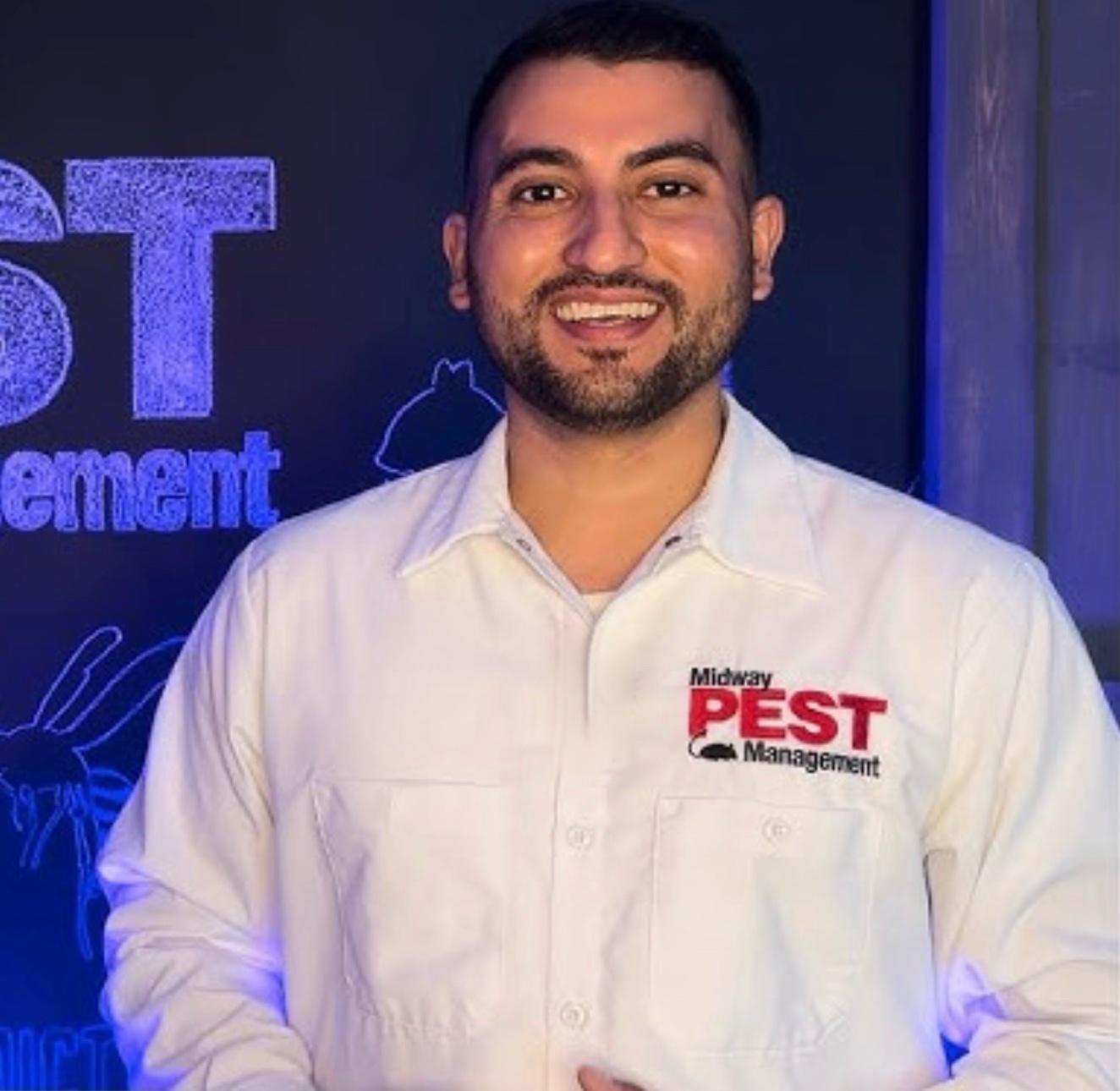
Dear Kansas City Homeowner,
“We stopped setting traps. The animal was never the problem. The opening was.“
My name is Luis Gonzalez. I own Midway Pest Management. I started this company because I love this work. There’s something deeply satisfying about solving a wildlife problem for a family, doing it humanely, and knowing the animal was handled with care and the home is protected going forward.
Here’s what changed. For years we set live traps, caught the animal, and moved it. It worked, in the sense that the animal was gone. But I kept getting called back to the same houses. Not the same skunk, a different skunk, in the same spot, because the gap was still there. Trapping treats the animal like the problem. It isn’t. The opening is the problem, and closing it is what you’re actually paying us to do.
So now we use one-way devices. The animal leaves on its own, at its own pace, out the door it already uses. It stays in the yard it knows instead of getting dropped somewhere unfamiliar to compete for a den it has no claim to. Nobody handles the animal, which means nobody gets bitten and nothing gets sprayed. Then we seal your structure, and that’s the part that lasts.
Sealing your home against wildlife is the heart of what we do, and it’s the work I’m proudest of. Every entry point we close is backed by a guarantee. If an animal gets back in through something we sealed, we come fix it, no charge, no argument.
My commitment on every wildlife job
Full inspection with every opening mapped, one-way exclusion devices sized to the species, monitoring until the space is confirmed clear, permanent structural seal-up, and a written prevention plan. No trapping, no relocation, and no animal ever separated from dependent young. If wildlife returns through an entry point we sealed, we come back at no charge.
Call us anytime. We’re right here in Olathe, and we love this work.
What KC-area homeowners say about our wildlife work
“So happy with our service and he went above and beyond to rescue a wounded bird from our window well! He was so kind and helpful. Would definitely recommend!”
“Roberto was able to find the source of our issue within 30 minutes, one that had evaded several other companies for over a decade! Prompt, efficient and professional!”
“Have really been pleased with the quality of pest control they provide. Roberto is very informed and detailed in his work.”
“The service we received from Midway was truly outstanding! They were efficient and kept a close eye on our situation. Luis was so kind and available whenever we needed help.”
“Luis was fantastic. Knowledgeable, professional, and took the time to explain everything clearly.”
“They came out to remove a bat in my house. Not only did they come in a very timely manner, they caught and removed it within minutes. Highly professional and friendly!”
Nuisance wildlife FAQ
Thorough answers to the questions Kansas City homeowners ask most about wildlife on their property.
Do you trap animals or relocate them?
No to both. We install one-way exclusion devices that let the animal leave on its own, then we seal the structural opening behind it. No cages, no bait, no handling, and nothing transported off your property. Non-venomous snakes are the one exception, because a snake already inside a structure has to be physically picked up and carried out, and it’s released outdoors on your property.
Do you seal the entry points?
Yes, and it’s the core of the service. Every structural entry point gets closed with heavy-gauge steel mesh, hardware cloth, and metal flashing that wildlife cannot chew through, and that work is guaranteed. Foundation penetrations, crawl space vents, soffit and fascia gaps, garage seals, utility entries, and roofline openings are all ours. For exterior dens under decks, stoops, and sheds, we clear the space of animals and confirm it’s empty, then recommend closing that area off. Those spaces do need to be sealed, or the next animal moves into the same spot.
Do you handle venomous snakes?
No. We remove non-venomous snakes from homes, but copperheads and timber rattlesnakes are outside what we take on. Send us a photo from a safe distance and we’re glad to help identify what you have, then point you to the right resource if it’s venomous. In the meantime keep your distance, keep pets and children away, and don’t try to handle or kill it, since that’s when most bites happen.
What animals do you handle?
Skunks, opossums, non-venomous snakes, groundhogs, and armadillos, plus raccoons, squirrels, bats, and birds which have their own dedicated service pages. Voles are handled through our rodent population control program. The exceptions are venomous snakes and large game animals like deer and coyotes, which require Kansas Department of Wildlife & Parks involvement.
There’s a skunk under my deck. Will it spray?
Very unlikely, because nobody goes near it. Skunks spray when they feel cornered or confined, which is exactly what a trap does. A one-way device does the opposite: the skunk leaves on its own at dusk, at its own pace, through the entrance it already uses, with no person anywhere near it. This is the biggest practical advantage exclusion has over trapping for skunks.
Isn’t it cruel to lock an animal out of its den?
It’s considerably kinder than the alternative. A relocated animal gets released into unfamiliar territory with no established den, no known food sources, and other animals already holding the good spots. Survival rates for relocated wildlife are poor. An excluded animal stays in the range it already knows and moves to one of the other shelter options within it. It keeps its home territory. It just loses your attic.
What if there are babies?
We check before anything goes up, and this is the main reason a real inspection has to come first. If dependent young are present, we hold the exclusion until they’re mobile enough to leave alongside the mother. We don’t seal a female away from her young, and we don’t take young animals off the property. Sometimes waiting a couple of weeks is the right answer, and we’ll tell you so.
How long does the process take?
Longer than trapping, and that’s the honest tradeoff. A device typically needs several days to a couple of weeks depending on the species and how many animals are using the space, and we don’t seal anything until activity has stopped completely. Sealing early is how an animal ends up dead inside a wall. That patience is what makes the result permanent.
Will the animal come back?
Not through anything we’ve sealed, and that’s what the guarantee covers. What we can’t promise is that a different animal won’t find a different opening somewhere down the road, which is why the prevention recommendations matter alongside the sealing. Close the gaps and remove the attractants, and your property stops being the easiest option on the block.
What about the mess they left behind?
Contamination cleanup is part of what we do. If an animal has been in your attic, droppings, urine-saturated insulation, and the odor that comes with it all need to be dealt with, and we handle that through full attic restoration: insulation removal, hospital-grade sanitization, deodorization, and TAP® insulation replacement. Not every job needs it, and we’ll tell you honestly when it doesn’t. What we don’t do is carpentry, so rotted fascia or damaged decking gets documented with photos and referred to the right trade.
How fast can you respond?
We’re based in Olathe and serve the entire KC metro, both sides of the state line. We respond within 30 minutes during business hours. Skunk calls get priority scheduling. For non-emergency wildlife situations, we typically schedule within 1 to 3 days.
Wildlife getting into your home?
We’ll get them out and seal it shut.
Skunks, opossums, non-venomous snakes, groundhogs, armadillos, and more. One-way exclusion, permanent structural seal-up, and expert prevention recommendations from a local team that genuinely loves this work. No trapping. No relocation. Free consultation.