
Wasps and Hornets Hub Page
Wasps near your home aren’t just annoying — they’re a genuine safety hazard.
Wasp and hornet stings send more Americans to the emergency room than any other venomous animal. Nests near doorways, playsets, eaves, and outdoor living areas are a serious risk — especially for children, elderly family members, and anyone with allergies. Midway Pest Management removes nests safely, treats entry points, and prevents rebuilding with quarterly prevention.
✓ Nest removal is included with every quarterly pest control plan — we remove paper wasp and mud dauber nests at every visit.
The real danger of wasps & hornets near your home
This isn’t about comfort — it’s about safety. Understanding what you’re dealing with helps you respond appropriately.
Stings can be life-threatening
Wasp and hornet stings cause localized pain and swelling in most people — but for the approximately 5-8% of the population with venom allergies, a single sting can trigger anaphylaxis. Children, elderly, and pets are at highest risk for severe reactions. A nest near a doorway, playset, or outdoor dining area creates daily exposure risk for your entire family.
They defend aggressively
Unlike honeybees that sting once, wasps and hornets sting repeatedly. Disturbing a nest — even accidentally by mowing nearby, closing a door, or walking past — can trigger a coordinated attack from multiple wasps simultaneously. Yellowjacket nests hidden in the ground are particularly dangerous because they’re invisible until you step on them.
Nests grow larger through summer
A paper wasp nest that starts as a small cluster in May can house 100+ wasps by August. Yellowjacket nests that begin with a single queen in spring can contain thousands of aggressive workers by late summer. The longer you wait, the larger the colony, the more dangerous the removal, and the higher the sting risk for your family.
Real nests we’ve pulled off KC-area homes
These aren’t stock photos. Every one of these came off a customer’s property in the Kansas City metro, removed in full protective gear.


Stinging insects found around KC-area homes
Different species build different nest types in different locations. Knowing what you have determines the removal approach and the safety precautions required.
Paper wasps
The most common wasp around KC homes. They build small, open-comb nests under eaves, porch ceilings, deck railings, door frames, and playground equipment. Nests are papery gray and shaped like an upside-down umbrella. Paper wasps are moderately aggressive — they’ll sting if the nest is disturbed but don’t typically chase. Nests are removed at every quarterly service visit.
Yellowjackets
Highly aggressive wasps that build enclosed nests — in the ground, inside wall voids, in attics, and inside dense bushes. Ground nests are the most dangerous because they’re invisible until disturbed by mowing or foot traffic. Yellowjackets are meat-eaters attracted to outdoor food, trash cans, and cookouts. Late summer colonies can contain 1,000-5,000 workers. Professional removal is strongly recommended.
Bald-faced hornets
Large, black-and-white hornets that build football-sized paper nests in trees, on building overhangs, and under eaves. They’re extremely aggressive when the nest is disturbed — attacking in large numbers and pursuing threats for significant distances. Bald-faced hornet nests should never be approached without professional equipment. These are the most dangerous stinging insect removal jobs we perform.
Mud daubers
Solitary wasps that build small mud tube nests on walls, under eaves, and in garages. Mud daubers are not aggressive and rarely sting — they’re actually beneficial because they prey on spiders. However, their mud nests are unsightly and multiple tubes can accumulate quickly on a home’s exterior. Nests are removed at every quarterly visit.
Cicada killers
Very large wasps (up to 2 inches) that dig burrows in lawns, flower beds, and along sidewalks. They look terrifying but are actually docile toward humans — males can’t sting and females rarely do. However, their burrowing damages lawns and landscaping, and their size causes alarm. Treatment targets the burrows directly.
Carpenter bees
Large, black bees that drill perfectly round ½-inch holes into wood fascia, deck posts, pergolas, and exterior trim. Males hover aggressively near holes but can’t sting. Females can sting but rarely do. The real damage is structural — repeated boring weakens wood over years, and woodpecker damage often follows as birds dig for larvae inside the tunnels. Treatment includes plugging existing holes and applying residual deterrent.
Why DIY wasp removal is dangerous
We get calls every summer from homeowners who tried to remove a wasp nest themselves and got stung — sometimes badly. Here’s why this is a job for professionals.
Store-bought sprays have limited range
Consumer wasp sprays shoot 15-20 feet and require you to stand directly below the nest. If the spray doesn’t kill every wasp immediately, the survivors attack the threat — you. For yellowjacket nests inside walls or in the ground, spray cans are completely ineffective because you can’t reach the colony inside.
Disturbed wasps attack in groups
When a nest is threatened, wasps release alarm pheromones that trigger a coordinated attack from every worker in the colony. A late-summer yellowjacket nest can deploy hundreds of stinging wasps in seconds. Professional removal uses protective equipment and techniques that minimize defensive response.
Hidden nests are the most dangerous
Yellowjackets in wall voids, ground nests under landscaping, and hornet nests high in trees require specialized equipment and techniques. Sealing a wall void entrance without killing the colony first can drive hundreds of wasps into your living space through interior gaps. Professional assessment before treatment prevents this scenario.
Our wasp & hornet removal process
Safe, effective, and designed to prevent rebuilding.
Species ID & nest assessment
We identify the species and locate the nest — including hidden nests in wall voids, underground, or inside landscaping. Yellowjacket removal is fundamentally different from paper wasp removal. The approach, timing, and safety precautions all depend on what you have and where it is.
Safe nest treatment & removal
We treat the nest with professional-grade products that eliminate the colony quickly, then remove the nest structure. For yellowjackets in wall voids, we treat through the entry point with dust formulations that reach the colony inside. For ground nests, we treat at dusk when all workers are inside. Proper timing and technique minimize defensive response.
Entry point treatment
We treat the area around the nest site with residual product to kill returning foragers and deter rebuilding in the same location. Wasps are attracted to sites where previous nests were built — the pheromone signature lingers. Treating the site breaks this attraction cycle.
Quarterly prevention — the permanent solution
Our quarterly pest control plans include wasp nest removal and entry point treatment at every visit. This means nests never grow beyond the early stage — we catch and remove them when they’re small, before they become a safety hazard. Quarterly prevention turns wasp management from an emergency into a non-issue.
Why quarterly pest control is the smartest approach to wasps
One-time nest removal solves today’s problem. Quarterly prevention means you never have the problem again.
We catch nests early — before they’re dangerous
A paper wasp nest in May has 5-10 wasps. By August, it has 100+. Our quarterly visits catch nests when they’re small and easily removed — before they become a safety hazard. You never have to worry about a large nest forming between visits because we’re there every 90 days.
Barrier treatment deters nest building
The exterior barrier we apply during quarterly service deters wasps from building nests on treated surfaces — eaves, soffits, porch ceilings, and window frames. This proactive treatment prevents nests from starting in the first place, rather than waiting for them to become a problem.
It’s cheaper than emergency calls
A single emergency yellowjacket removal costs more than a full quarter of preventive service. And one-time removal doesn’t prevent the next queen from building a new nest in the same spot next spring. Quarterly prevention handles wasps, ants, spiders, and all common household pests — all in one plan.
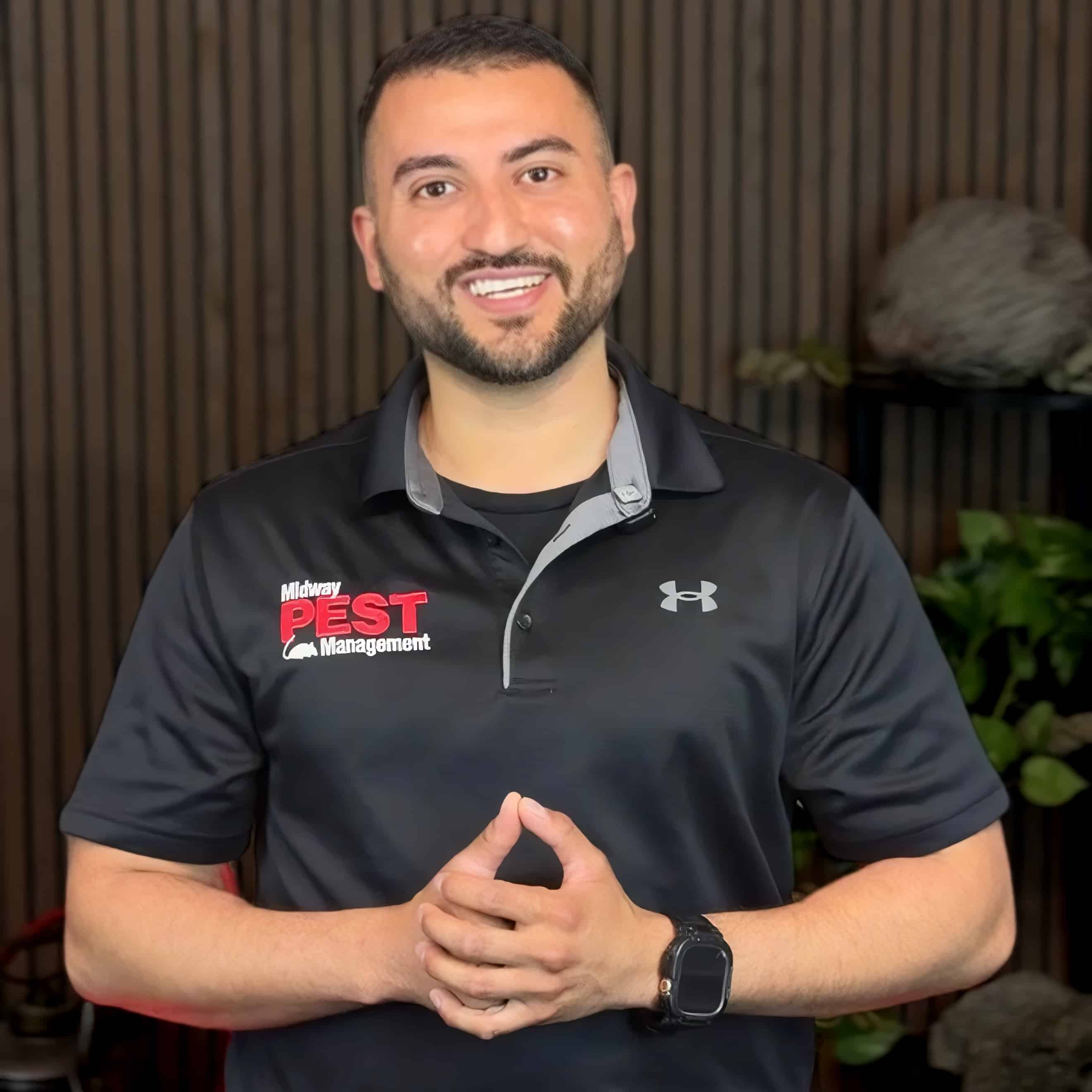
Dear Kansas City Homeowner,
“Wasp nests near your family are a safety issue — not something to wait on.“
My name is Luis Gonzalez. I own Midway Pest Management. Every summer we get calls from families dealing with wasp nests near their front doors, above their porches, and around their kids’ play areas. By August, some of these nests have grown to hundreds of wasps. That’s a genuine safety emergency.
The solution isn’t one-time removal — it’s quarterly prevention. When we visit every 90 days, we remove nests while they’re small and manageable. We treat entry points so new queens don’t rebuild in the same locations. And we maintain a barrier that deters nest building on your home’s exterior. You stop worrying about wasps entirely.
My guarantee
Wasp nest removal is included with every quarterly plan visit. If you find a new nest between visits, call us — we come back and handle it at no extra charge. Money-back + $25 guarantee on all quarterly plans.
What KC homeowners say
“Very knowledgeable. Explained things in detail. Found yellow jackets at places we didn’t expect. Very pleasant. Thorough job. I would use them again.”
“I’ve been using Midway Pest for a while and they have been amazing! Seeing less and less bugs. 10/10 recommend!”
“Luis was fantastic. Knowledgeable, professional, and took the time to explain everything clearly.”
“Great job. Luis very polite, professional, and respond quickly. Price is very competitive.”
“I have been using Midway since 2019. Communicative, prompt, knowledgeable, thorough and fairly priced.”
“Extremely efficient and reliable work! Am so grateful for Luis!”
Wasp & hornet FAQ
Questions KC homeowners ask most about stinging insects.
How dangerous are yellowjackets compared to paper wasps?
Significantly more dangerous. Yellowjackets are highly aggressive, sting repeatedly, and attack in large numbers when their nest is disturbed. Paper wasps are moderately defensive and typically only sting when the nest is directly threatened. Yellowjacket nests — especially ground nests and wall-void nests — should always be handled by a professional.
Can I just knock down a wasp nest myself?
Small paper wasp nests with a few wasps in early spring — possibly. But any nest larger than a golf ball, any yellowjacket nest, any hornet nest, or any nest in a wall void should be handled professionally. The risk of multiple stings increases dramatically with colony size, and allergic reactions can’t be predicted from previous sting history.
Why do wasps keep building in the same spot?
Pheromone residue from previous nests attracts new queens to the same location. Even after a nest is removed, the chemical signature persists on the surface. Our treatment includes residual application at nest sites that neutralizes this attraction — breaking the rebuild cycle. Without treatment, new nests appear in the same spot every year.
When is wasp season in Kansas City?
Queens emerge from hibernation in April-May and begin building nests. Colonies grow through summer and peak in August-September. Yellowjackets become most aggressive in late summer as food sources decline. Fall brings the final burst of activity before the colony dies off and new queens seek hibernation sites. Quarterly treatment from spring through fall prevents nests from ever reaching dangerous size.
What if someone in my family is allergic?
Wasp nest removal becomes a medical priority. Call us immediately — we offer priority scheduling for homes with allergy concerns. In the meantime, avoid the nest area, keep windows and doors near the nest closed, and ensure anyone with a known allergy has their EpiPen accessible. Don’t attempt DIY removal under any circumstances.
Does quarterly pest control really prevent wasps?
Yes. At every quarterly visit, we remove any existing nests (catching them while small), treat entry points with residual product, and maintain an exterior barrier that deters nest building on treated surfaces. Customers on quarterly plans rarely deal with established wasp nests because we catch them before they become a problem.
Wasp nest near your family?
Don’t risk it. Let us handle it safely.
Professional removal with quarterly prevention so nests never become a safety hazard again. Free consultation, money-back guarantee.