
Spider Control Kansas City | Brown Recluse Experts | Midway Pest
Most spiders in your home are there because something else is.
Spiders do not come inside for your house. They come inside for the insects already living in it. We treat the spiders you see and the insect population that brought them, and we handle brown recluse and black widow as their own service with their own evaluation.
✓ Common house spiders are covered under quarterly pest control — including web removal and harborage treatment at every visit.
Spiders follow food — which is why spraying them never holds
Spider problems tend to show up alongside ant, beetle, and fly activity. Treating the spider without touching what it eats buys you a few weeks at most.
They are predators, not invaders
A spider indoors is a spider that found a reliable food supply indoors. Cellar spiders in a damp basement, house spiders in a garage corner, wolf spiders hunting across a floor at night — every one of them is there because insects are there.
This is why the webs come back after you knock them down. The reason they were built has not changed.
Quarterly works on both ends
Our quarterly service handles common house spiders directly, with web removal and treatment of the harborage and entry points they use. It also reduces the general insect population across the property.
Fewer insects means fewer reasons for spiders to stay. That is what makes the result last instead of resetting every few weeks.
Late summer is when you notice
Most spider calls come in from late summer into fall. Spiders that spent the season outdoors move toward structures as temperatures drop, and wolf spiders in particular start showing up indoors during that window.
Brown recluse are the exception. They are active indoors year round because they never leave in the first place.
What quarterly covers, and what it does not
We would rather tell you this before you pay than after. Common spiders and the two medically significant ones are handled differently because they behave differently.
Common house spiders
Cellar spiders, common house spiders, wolf spiders, jumping spiders, grass spiders, and orb weavers are all covered under quarterly pest control. That includes web removal and treatment of the entry points and harborage they use.
These species are nuisance pests. They are not aggressive and their bites are not medically significant. For most homes, quarterly is the entire answer to a spider problem.
Brown recluse and black widow
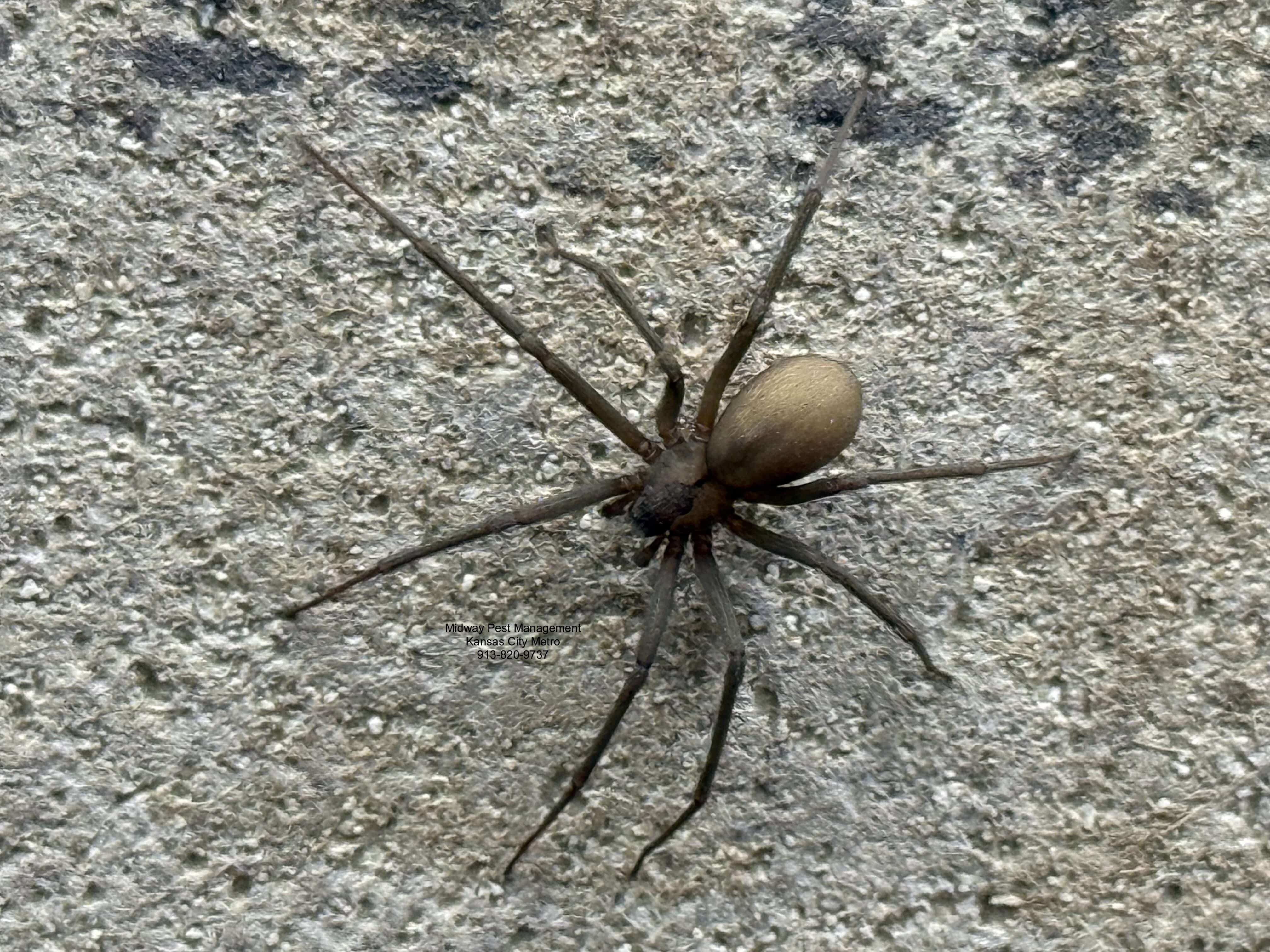
Brown recluse. Uniform tan to brown, no banding on the legs, six eyes in three pairs rather than eight.
These two require their own onsite evaluation. We inspect harborage areas, identify how far the population has spread, and build a treatment plan around what we actually find.
They are not covered under quarterly because a perimeter treatment does not reach where they live. Recluse in particular nest in undisturbed interior spaces, which means the work happens inside, not around the outside.
Spiders KC homeowners bring to us most
Kansas City sits inside the natural range of the brown recluse, which is why this region takes identification seriously. It also means a lot of harmless spiders get mistaken for dangerous ones.
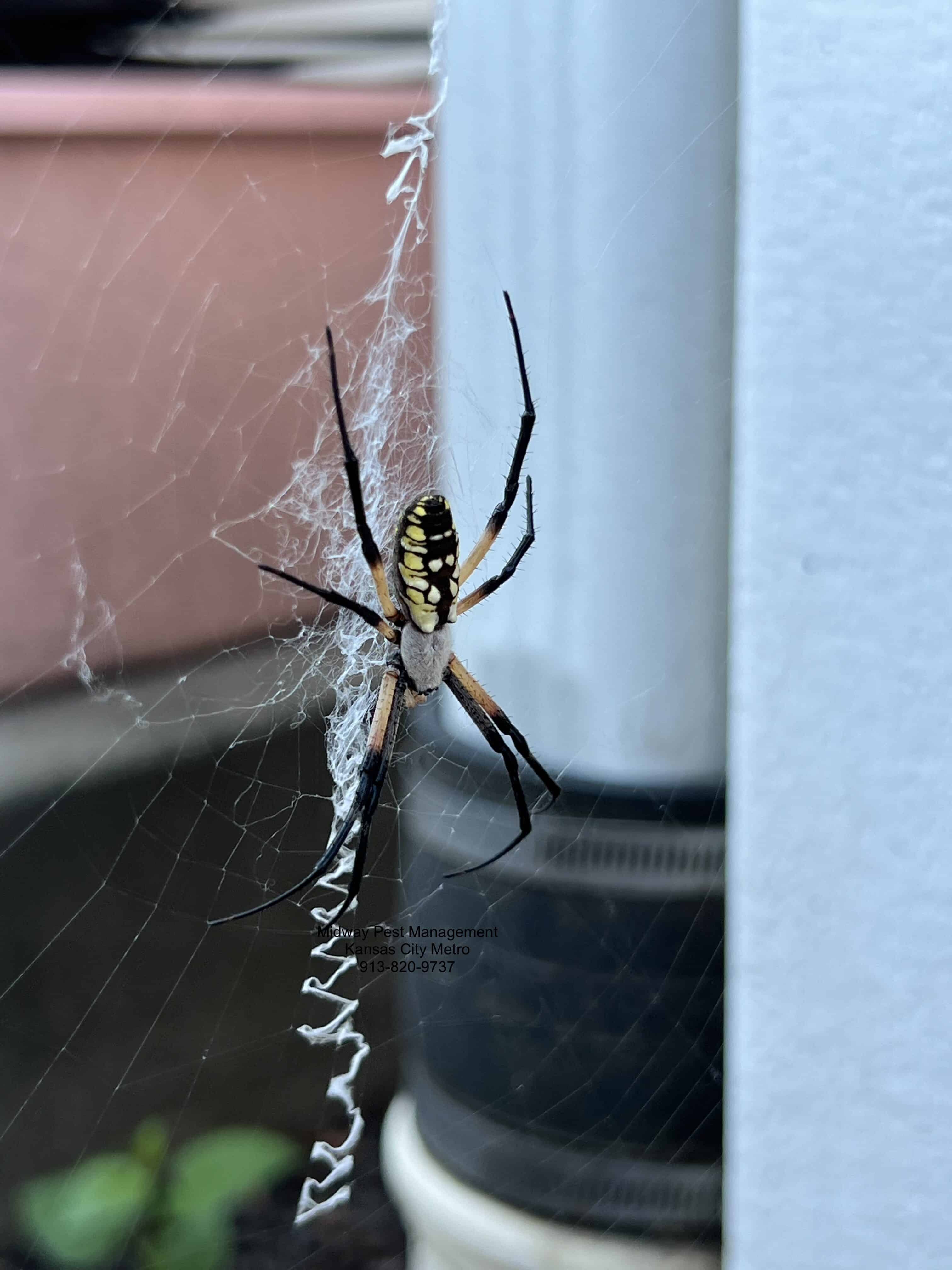
Yellow garden spiderArgiope aurantia. The large black and yellow spider people find in gardens and on porches in late summer. Alarming to look at, harmless to people, and genuinely useful in the yard.
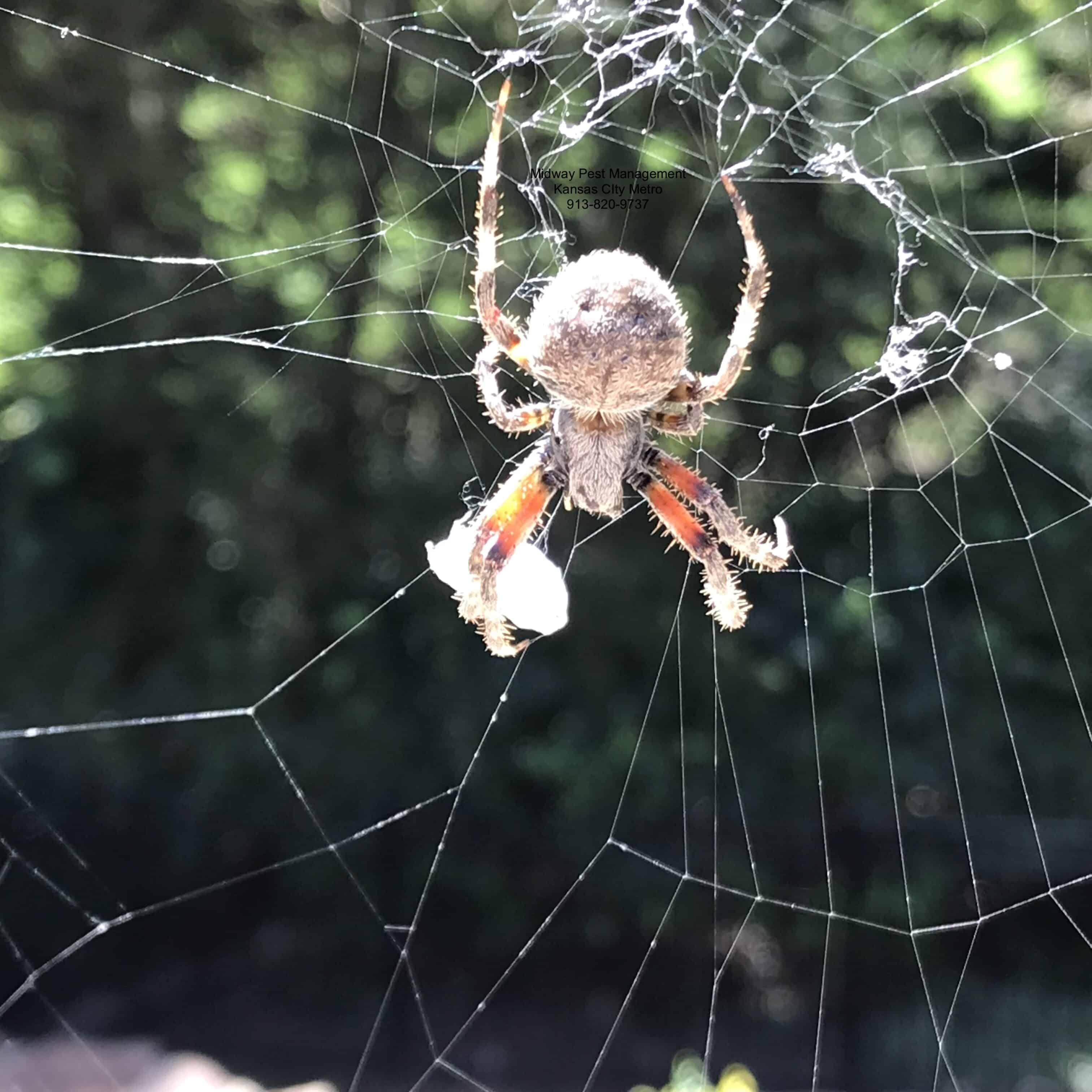
Spotted orb weaverNeoscona crucifera. Builds a fresh circular web most evenings, often across a doorway or between porch rails. Also harmless, and the usual reason someone walks face first into a web at night.

Where families actually find themSpiders web up whatever sits still. Playsets, sandbox lids, and toys left out overnight are some of the most common places KC parents run into one, which is why exterior harborage matters.
Our spider control process
Identification first. Treating a recluse problem like a house spider problem wastes your money.
Identify the species before we treat
Product selection and placement change depending on whether we are working on a web builder or a ground hunter. We identify what you actually have first, and when recluse is suspected we place monitors to confirm activity and map where the population is concentrated.
Treat the harborage, not just the surfaces
Web removal and a perimeter spray look good on the day of service. Treating the cracks, voids, and undisturbed harborage is what keeps them from being back in three weeks. Every product is applied in accordance with its EPA label, placed where it does its job and stays out of the way of the people and animals living there.
Where the work actually happens
Crawl spaces, because they are dark, undisturbed, and usually humid. Main living areas, behind baseboards and in closets and storage, which is where recluse activity is most often reported. And attics, where insulation and stored boxes give cover year round and untreated activity comes back down into the house.
Keep the food source down year round
Our quarterly pest control plan keeps the general insect population down across the property, which is what removes the reason spiders were there in the first place. It covers common house spiders along with ants, beetles, and the rest of KC’s usual household pests.
What we do not do
You should know this before you hire us, not after.
We do not fumigate
Severe, established brown recluse infestations sometimes call for fumigation. We do not provide fumigation services, and we are not going to pretend otherwise to keep the job.
We will tell you and refer you out
If we evaluate your home and believe that is what the situation actually requires, we will say so and point you toward a company that does it. We are not going to sell you repeat treatments for a problem that needs a different solution.
That situation is uncommon
Most recluse work is handled with inspection, targeted treatment, and monitoring that verifies the result instead of assuming it. Very few homes reach the point where fumigation is the honest answer.

Dear Kansas City Homeowner,
“Anyone promising one spray will wipe out brown recluse is not being straight with you.“
My name is Luis Gonzalez. I own Midway Pest Management here in Olathe. Spiders are where I see the most bad information in this industry. Homeowners get sold miracle sprays, set off foggers that push recluse deeper into the walls, and lose sleep over spiders that were never recluse in the first place.
We do it differently. Identify the species properly, treat where spiders actually live, and tell you the truth about what control looks like — including when the answer is a service we do not provide. We keep an entomologist on call, because in recluse country knowing exactly what you are dealing with matters. And I recommend you get two or three estimates before you decide.
My guarantee
Quarterly pest control is backed by our 100% satisfaction money-back guarantee plus $25. If you are not happy with the service, it is better than free.
What KC homeowners say
“Roberto was able to find the source of our issue within 30 minutes — one that had evaded several other companies for over a decade!”
“I was so impressed with Roberto’s knowledge. I feel very confident that he will get this issue taken care of.”
“Luis was fantastic. Knowledgeable, professional, and took the time to explain everything clearly.”
“On-time service, very knowledgeable technician. Process explained thoroughly, all questions answered completely.”
“The service we received from Midway was truly outstanding! Efficient and they kept a close eye on our situation.”
“Extremely efficient and reliable work! Am so grateful for Luis!”
Spider control FAQ
The questions KC homeowners ask us most about spiders.
Is spider control included in quarterly pest control?
Common house spiders are, including web removal and treatment of harborage and entry points. Brown recluse and black widow are not, because those require an onsite evaluation and interior treatment that a quarterly perimeter service does not cover.
Why do spiders keep coming back after I spray?
Because the insects they eat are still there. Spiders are predators and they go where the food is. Treating the spider without reducing its food source usually buys a few weeks. That is why our quarterly service addresses the general insect population rather than just the spiders you can see.
Do I really have brown recluse, or is it a house spider?
Most spiders people identify as recluse are not. The reliable markers are six eyes in three pairs rather than eight, uniform coloring with no banding on the legs, and a preference for undisturbed indoor spaces. If you are unsure, keep the specimen if you can do so safely and we will identify it during the evaluation.
Are your treatments safe around pets and kids?
We use high quality products applied in accordance with their EPA labels, placed in harborage areas rather than open living surfaces. Tell us about pets in the home when you book and we will plan placement and re-entry timing around them.
What if the recluse problem is severe?
Heavy established infestations sometimes require fumigation, which we do not provide. If your situation calls for it we will say so and refer you to a company that does that work. Most cases do not reach that point.
What time of year are spiders worst in Kansas City?
Late summer into fall is when most calls come in. Spiders that spent the season outdoors move toward structures as temperatures drop, and wolf spiders in particular show up indoors during that window. Brown recluse are active indoors year round because they never leave.
Not sure what you are dealing with?
Send us a photo and we will tell you.
We will tell you whether it is a quarterly issue or something that needs its own evaluation, and we will be straight with you either way. Free estimates, free consultations, same-week service.